Thursday, 31 October 2013

The Birth of the Claydon Skiff

The Claydon skiff came about when people in the maritime industries of Felixstowe and Harwich wanted to row and compete.
Philip Cunningham has kindly sent a clip from a newspaper of the time, sadly with the name cut off but I think it must have been a company newsletter.
The author, Don Black, wrote:
Tugmen of Felixstowe have commissioned, in one gala day, the £3.2m tug Trimley – and a fleet of skiffs to race in their leisure time.
[The tug was remarkable for being crewed by just five men.]
That is the same number needed for each of the five racing skiffs, which this summer will be rasing money for good causes along the coast and estuaries of Essex and Suffolk.
The glass fibre hulls of these 24ft craft come from a mould discovered by chance in a field, then fitted out by tugmen of Alexandra and Felixarc companies at Felixstowe and boatmen and shore staff of Harwich Haven Authority.
Each insured for £3,500, they will be seen racing for RNLI funds from Walton-on-the-Naze to Harwich on June 15 and from Clacton to Walton on July 27.
Their dedication by the Rev. Alan Rawe, from Felixstowe International Seafarers' Centre was followed by naming ceremonies that brought a touch of sadness to an otherwise sunny day.
One commemorates Cliff Marks, among six men in the tug Hawkstone who were all lost in a storm in the Thames estuary.
Another remembers Russel Marsh, only son of Pauline and Brian Marsh, chief engineer of the tug Ganges. Russel lost his fight for life at the young age of seven. The boat bearing his name has been given by his mother.
First to be named was the Alf Saunders, who died shortly after retiring from a lifetime of service on the Thames as a freeman of the river and at Felixstowe as an Alexandra captain.
Representing Felixarc RC is a skiff named Gary John Gray [who] died in a tragic road accident in 1963 at the age of 17.
The fifth skiff belongs to a club formed by boatmen and shore staff of Harwich Haven Authority and is named Vicson, for their chief executive Capt. Victor Sutton.

No indication as to why they were known as Claydon skiffs, but Claydon is a village on the River Gipping near Ipswich.
More on the early days of the Claydons later.

Wednesday, 30 October 2013

Bunking off again....

The next chapter of my history of the Claydon Skiffs has been delayed yet again, this time by a weather window that could not be ignored. Took Lotty out at 08.00 for a quick thrash to Marker, the post on the right with the beehive on top. Such a contrast with last weekend. And the forecast for next weekend is fairly rubbish too. Got to take an opportunity when you can at this time of the year.
Here is the view towards Emsworth with the South Downs behind.

Tuesday, 29 October 2013

Seax Gig ready to splash

The Seax gig is finally ready for launch, and she looks superb. Designer and builder Keith Webster sounds fairly chipper too, as well he might for he has found a home for it (but that isn't him in the picture - that is Adrian Mather, rower and unicyclist supreme). Keith writes:
"There is a bit of a rush to get her on the water as a small group of us have started a new club, Southend Coastal rowing club. If she goes well it looks like I may have a couple to build in short order.
Cheers, Keith"
The founding of another rowing club is always good news. Southend CRC aims to provide all sorts of rowing from sliding seat racing to casual pottering. They even have a stated ambition to do the Celtic Challenge, a 90 mile race from Ireland to Wales for certified lunatics only.
The club already has a sliding seat coxless pair and the Seax gig will soon join the fleet. 

Sunday, 27 October 2013

Clayton or Claydon?


At Langstone Cutters we have always called our big grp boats Clayton Skiffs. Everyone does. I assumed that the word 'Claydon' on the silver cup awarded at the Great River Race was simple engraver error.
Wrong! 
Philip Cunningham of Manningtree Witchoars has sent me a clipping from the East Anglian Daily Times dated June 3, 1991, which describes the first race of five new 'Claydon' skiffs up the River Deben.
The fleet was made for the Alexandra Towing Company in Felixtowe. Crews from many local companies rowed them extremely aggressively.
A couple of members of the original crews have been in touch, so more tomorrow.

Friday, 25 October 2013

Another Big Man in a Small Boat


Remember my Simbo, the one sheet boat from the designs at Hannu's Boatyard?
Now a Californian named Ralph has launched another of Hannu's amazing designs, the Micro Auray Punt.
Filmed at Shoreline Park, Mountain View, the boat handles his 6ft frame with aplomb.
It looks like a super job. Ralph even made the oars himself, but as he used cheap pine he doesn't expect them to last very long.
The launch is reported in the 'Splash' section of Duckworks Magazine, which also features one of Hannu's single sheet kayaks.

Tuesday, 22 October 2013

The Open Boat


The Open Boat presses so many of my buttons it is like the Lost Chord of rowing for me. It is extremely clever and favours simplicity, economy and speed of construction over any considerations of craftsmanship or good taste. And the inventor, Jim Flood, is a rowing coach in Reading. As I only this Sunday qualified as a rowing coach (albeit at lowly Level 2) this makes him a comrade in arms.
It is made of a metre-wide, inch-thick sheet of a foam plastic normally used to crate up electronic equipment for shipping. Jim Flood simply folds the ends up, welds them together to make a bow and stern, and attaches lengths of pine as gunwales. I particularly like the way he doesn't bother with fussy details like sanding or varnishing - when the boat hits the water all the wood is finished exactly as it left B&Q.
The Open Boat seems to row just fine (make sure you watch part 2 of the video here) but there are some technical issues that might need to be addressed before the design can be regarded as totally finished, which are discussed in depth by the experts on the excellent Duckworks forum.
Jim Flood has a link on his site to the extraordinary sturgeon-nose canoe of the American Ktunaxa Nation, which may indicate a shape that would bring the bow up and reduce the hogging in the centre of the boat that the building method tends to create.
Jim's aim is to create a sliding seat rowing boat for developing countries, but I want to know how this method can be adapted for beamier fixed seat boats. It would involve either obtaining sheets of foam wider than a metre or welding two sheets together I suppose. Any ideas?

Saturday, 19 October 2013

Pair rowing

Pair rowing is something that scares me rigid, to be honest. In a fine boat particularly it is a recipe for tipping over and getting all wet, and coxless pair rowing is a recipe for hitting the bank then tipping over and getting all wet.
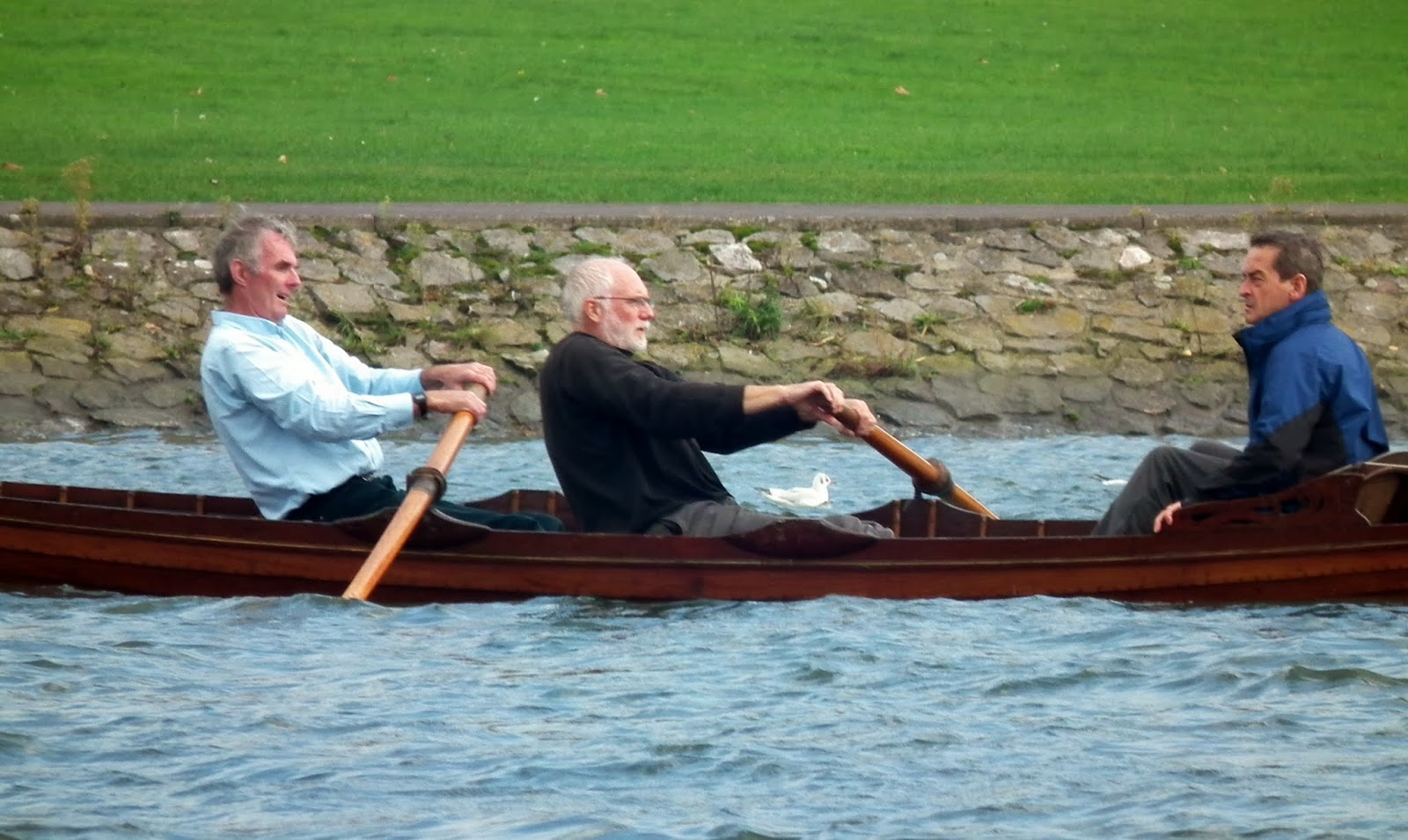
So I got in the lovely century old pair skiff at St Denys Sailing and Rowing Club on the Itchen with some trepidation. Luckily we had a cox in the form of boatbuilder, canoeist and sailor supreme Graham Neil, and John Gingell in the bow is a coastal rower and knows what he is doing so all was well. After an initial wobbly period while we got used to each other things went swimmingly, by which I mean we did not have to do any swimming at all.
Love the gull....