A couple of years ago I visited St Denys Sailing and Rowing Club on the River Itchen in Southampton, and tried out their Victorian racing skiff Merlin, which is a thing of beauty and a symphony in varnish.
The downside, literally, was the depth the little boat was driven to by a rower clearly a lot bigger than she was designed for (as you can see, even with the stretcher at its furthest my knees are way up in the air).
Yesterday I revisited the club with the Home Built Boat Rally. It was great to catch up with them all and also to try Merlin again.
I had hoped that losing a couple of stone with my low carb diet would mean she would ride higher and prouder in the water, but as you can see the difference is minimal. <Sigh>
Removing the stretcher entirely meant I could get my legs straight, but after this picture was taken I found it was impossible to get any pressure on without it so I put it back in and had a bit of a knees-up, so to speak.
Monday, 27 May 2013
Sunday, 26 May 2013
Appropriate Boats (2)
This is the sort of crappy picture you get when you grab the camera and fire a few shots off at random as you mill about on the start line of a race but it captures the start of a mini-disaster caused by choosing the wrong boat for the occasion.
The occasion was yesterday's Round Osea Island row, a six mile hack up the lovely River Blackwater in Essex. Osea Island is a private retreat that you can only row round at high tide - the rest of the time it is blocked by a causeway (local estate agents get this the wrong way round - they selfishly believe that the causeway is blocked at high tide).
Langstone Cutters took our Clayton skiff Gladys, a brute of a boat but bulletproof and capable of taking almost any sea. It was a great row, with skies that started a bit overcast (the pictures exaggerate the overcastness because I had to use Picasa's 'I'm feeling lucky' feature which doesn't handle water very well) but brightened up considerably as the afternoon wore on. There was a stiffish northerly wind though, which brought up a bit of a chop.
You will have seen which way this is going. Spotted that coxless quintuple sculling boat? She started off badly when she was cut up ruthlessly at the first buoy by some boat or other <innocent face> and immediately they turned abeam of the wind the crew was bailing hard. They were seen sinking half way round and had to put in at a neighbouring yacht club.-
Friday, 24 May 2013
Appropriate Boats
This amazing video came from the 2013 Vogalonga in Venice a few weeks ago. A racing four has got its bow caught between a pair of posts just the other side of a bridge, and the current has swept the stern to the other side of the bridge, wedging the boat helplessly across the channel.
The crew are helpless. They can't reach either the bow or the stern to push themselves free (the bow man tries but can do nothing). A forceful cox might have been able to get out by ordering vigorous backing down on bow side, but he does nothing. In fact, the whole crew seems paralysed.
Meanwhile, a queue of truly Italian proportions has backed up behind them, and none of the assorted gondolieri do anything to positive to assist either, just catcalls. The only help the poor sods get is from a couple of kayakers who manfully but slowly shift the stern back until they are finally released.
It shows that just because you can row a fine boat down the Grand Canal it doesn't mean you should. Fine boats are meant for racing in the highly controlled environment of Dorney or Henley. In the real world, the rowers can do little for themselves. Watch one going through a lock if you want a good illustration of what I mean. The cocktail-stick shape means they can't safely let go of the blades so the boat is effectively wider than the lock, and when they do let their blades trail the outriggers prevent them from holding on to the chains.
The lesson? If you want to row in the real world, use a real-world boat with a decent beam so you can move about the boat and ship the oars when necessary, fixed thwarts so you can move about while sitting, and a few fenders. Leave the racing shell on the lake.
Saturday, 18 May 2013
Picomicroyacht does Land's End
What a stunning picture. It's Robin Morris's row/sail Laser Picomicroyacht, which I wrote about last year when he rowed across the Channel.
His latest exploit, recounted in his Picomicroyacht blog, is to row round Land's End from Sennen Cove to St Micheal's Mount, a distance of 19nm through some of the most alarming waters anywhere. Lots of rocks exposed to winds and waves that have all the way from America to build up. He gives a fascinating account of the perils of the voyage, with lots of pics of the disturbing seas you experience on that part of the coast.
Tuesday, 7 May 2013
Silence
No posts for over a week...the weather must have improved. In fact, it has suddenly gone wonderful, with cloudless blue skies and glorious sun. So I've been out rowing quite a bit.
On Wednesday it was a leisurely paddle round the harbour in the afternoon in a Teifi skiff. There were four of us, which is a bugger as it means there is one too many for a two-man+cox Teifi but one short of a four-man+cox galley. So we took both Teifis, one rowing in the bow with the other coxing.
Teifis are horrendous to row two-up but coxless. They weathercock hard, trying to lie abaft the wind, so the rowers have to communicate extremely well if they are to keep on the right course without fighting each other. The best method is for the bow to call a landmark on the shore for both rowers to lock on to. But for a leisurely paddle the easiest thing to do is for one to row and the other to take the rudder. It makes conversation easier too.
On Thursday I spent most of the day in the back of an adventure gig trying to tell a much of insurance agents how to row. Most of them got the idea well, except for a young bloke who had rowed twice with a gig club and knew it all. His timing was all over and he dug his blade in so deep it was a danger to bottom-feeding fish. And he wouldn't be told.
Saturday morning was spent with members of Langstone Cutters Gig Club who hadn't gone to the World Championships in the Scilly Isles. They were a novice crew but were great - paid attention and implemented the advice. They will be great rowers very soon.
Sunday - more tooling round the harbour.
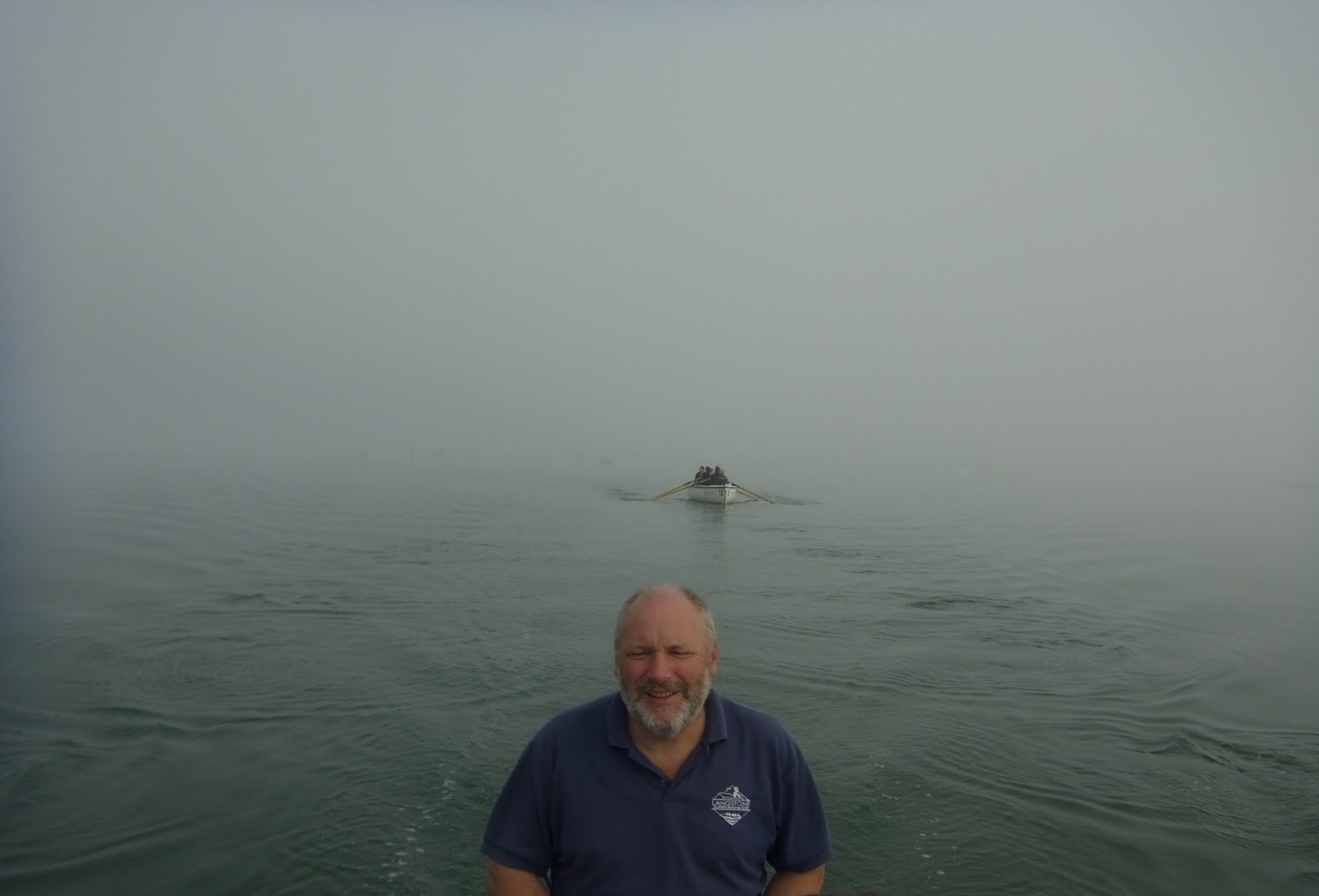
But Monday, a bank holiday here in England, was the highlight. We took Gladys and Mabel out first thing into the fog, which gradually lifted into a lovely sunny day (the picture shows Mark Taylor coxing Gladys, with Mabel looming in the background). Then we went on shore for a fried breakfast with all the evil stuff that non-rowers aren't allowed - black pudding, fried Spam, sausages, bacon, duck eggs, and fried bread. Yum.
Monday, 29 April 2013
Depoe Bay Wooden Boat Show 2013
John Kohnen has posted lots of pics of the Depoe Bay Wooden Boat Show on the Pacific coast of Oregon, including this one of Dennis Banta, who is 6ft 2in, rowing his new tender to his stylish tug-style boat.
Reminds me of another tall person in a small boat.
But Dennis's boat is actually rather capacious and could fit two, although they both look very apprehensive.
But my favourite picture is of some kids in a couple of boats taken to the festival by Andy Linn of the Toledo Community Boathouse. At top right is their Mollyhawk, a very attractive sculling boat designed by John Welsford, about to T-bone Aurora, a canoe designed by Andy himself - the plans are here.
What I like about the picture is that every single one of both crews is laughing fit to bust. Rowing is fun!
Reminds me of another tall person in a small boat.
But Dennis's boat is actually rather capacious and could fit two, although they both look very apprehensive.But my favourite picture is of some kids in a couple of boats taken to the festival by Andy Linn of the Toledo Community Boathouse. At top right is their Mollyhawk, a very attractive sculling boat designed by John Welsford, about to T-bone Aurora, a canoe designed by Andy himself - the plans are here.
What I like about the picture is that every single one of both crews is laughing fit to bust. Rowing is fun!
Saturday, 27 April 2013
St Ayles Skiff on the telly
A lot has been going on in the St Ayles skiff scene. A very nice little prog on Reporting Scotland has Andrew Anderson interviewing Alec Jordan and going out with the ladies of Anstruther. A very clear exposition of just why the boat has taken off so fast - Alec is about to sell his 100th kit.
And Coigach have launched their second boat, Lily-Rose.
The Blakeney boat has got a coat of primer inside, and the crew are already getting out and practicing for the launch.
Everyone seems to be keenly anticipating the first World Championships at Ullapool in July.
And Coigach have launched their second boat, Lily-Rose.
The Blakeney boat has got a coat of primer inside, and the crew are already getting out and practicing for the launch.
Everyone seems to be keenly anticipating the first World Championships at Ullapool in July.
Subscribe to:
Posts (Atom)