Saturday, 29 May 2010

Home Built Boat Rally on Barton Broad

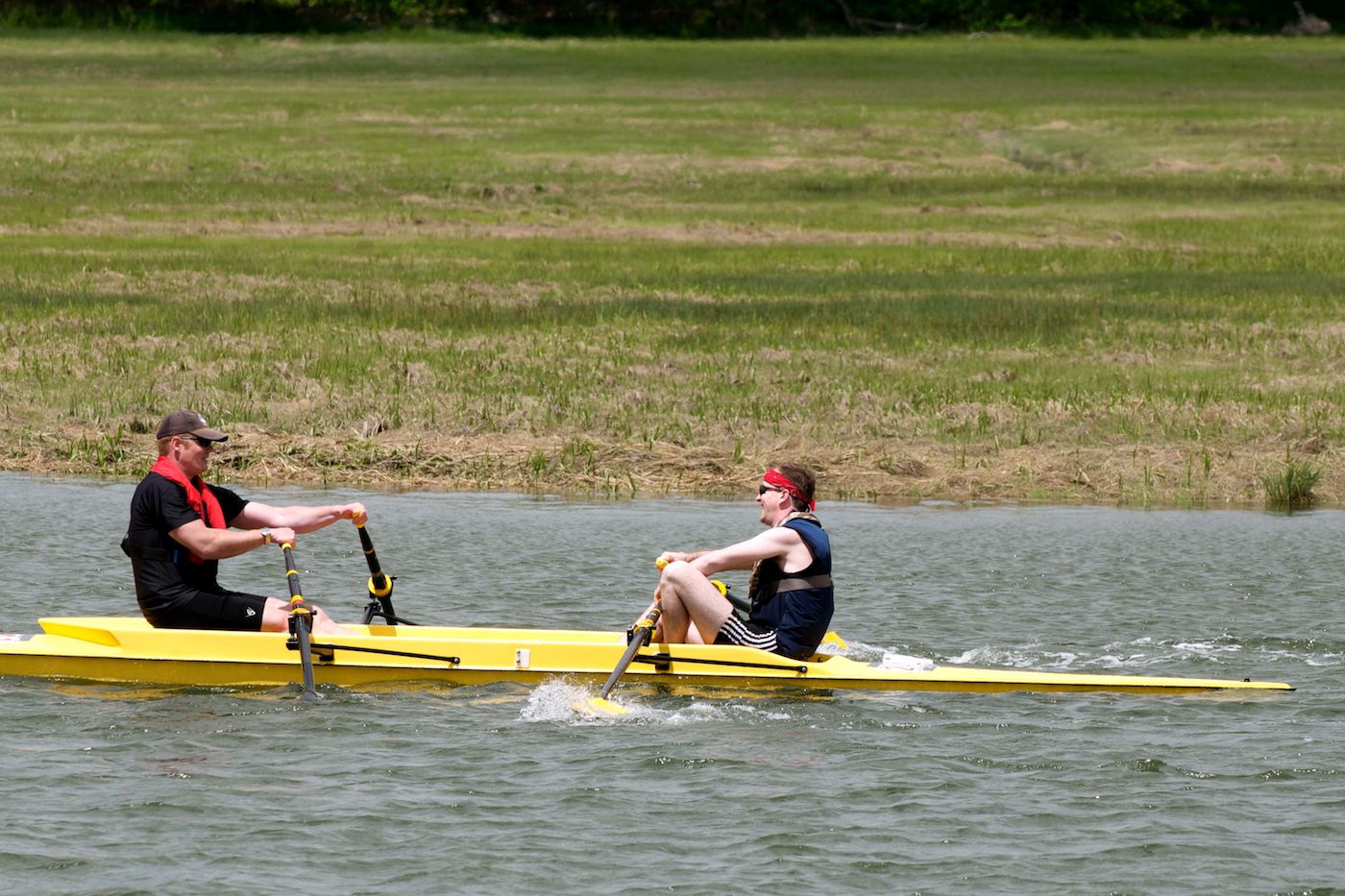
I'm at the Home Built Boat Rally at Barton Broad, and it's raining. But that didn't stop me taking a couple of turns round the island between the staithe and the broad practising the 'shoulders down' rowing technique that rowing coach Julia Rooke taught me the other day - I have clearly got into some very bad habits in all those years sculling on my own.
Now I go so fast I nearly rammed Graham Neil who was rowing his new Andrew Wolstenholme-designed Coot dinghy. It would have been a crying shame to scratch such lovely paintwork.
Behind him is a beautifully built Stevenson Weekender that was featured in Water Craft recently.
Now, the BBQ. Tomorrow the weather should be better with any luck.

Thursday, 27 May 2010

Yachting Caps (derision rightly directed at)

Captain JP has a yachting cap dilemma. It is a knotty problem, the hat thing. Many sailors of enormous experience and seniority regard the Breton cap as a symbol of authority. But many younger, ruder sailors say wearing a Breton cap is a sure sign of moral turpitude and mental collapse. And fashion brain-death.
What is clear is that the cap, a practical and stylish tile especially for those of us who might be follically challenged, is now under attack. I blame the rise of the moronic baseball cap. And of course this image, from the funniest film ever, Some Like it Hot:

Wednesday, 26 May 2010

Rowing to Hampton Court, Tudor-style

The Thames Traditional Rowing Association had its annual Tudor Pull over the weekend, rowing a bunch of shallops, wherries and Thames Waterman's cutters from Hampton Court to the Tower of London in full fig, which is not quite an authentic recreation of Tudor boating garb but does involve medieval-style flat hats, canopies over the passengers and lots of flags.
Trinity House rower Joe Lane, who supplied the pictures, described the weather as "a little too intense heat-wise" but clearly everyone had a blast. Joe describes the event:
"The Tudor Pull is a ceremonial event for Thames Watermen's Cutters which is organised each year by the Thames Traditional Rowing Association (TTRA). The cutters escort the Thames Royal Shallop 'Jubilant' rowed by members of the Company of Watermen and Lightermen from Hampton Court Palace to the Tower of London to deliver a 'Stela' to the Governor of the Tower for safekeeping. The 'Stela' is a piece of medieval water pipe made from a hollowed tree trunk which stands on a base of timber from the old Richmond Lock and which bears the coat of arms of the Waterman's Company."
Here is the crew passing the Palace of Westminster, 'tossing oars' in salute.
There are lots more of Joe's pictures here.
Joe recently took part in a 100 mile, 24 hour row from Southend Pier to Windsor in aid of Help for Heroes, and you can help as well by taking firm hold of your credit card and clicking on www.justgiving.com/h4h100.

Tuesday, 25 May 2010

Charles Courtney, sculler

Goran Buckhorn at Hear the Boat Sing focuses today on the controversial career of the American sculler Charles Courtney. In the late 19th century, professional rowing existed mainly for gambling and huge amounts were wagered on the results. For some reason that has never been explained, Courtney failed to make the finishing line on several occasions. In 1887 he was poisoned by a cup of iced water he drank on the night before a critical race with James Riley, and in 1879 on the morning of his challenge race with Ned Hanlan for the world championship his boat was mysteriously found sawn in half. And in 1880 in another race against Hanlan, Courtney responded to Hanlan taking an early lead by simply rowing back to the start/finish line without going round the turning post.
Why? Courtney was an innovative rowing theorist, developing a new and very successful rowing style, and took an unusually puritanical line on fitness. He never drank nor smoked himself and in his later extremely successful career as a coach insisted on his crews abstaining also. On one occasion he sacked most of a crew for eating strawberry shortcake before a regatta, going on to win with a mainly substitute crew made of sterner moral fibre.
But what really endears Charles Courtney to me is a story I found in his entry in Wikipedia:
At 12, Courtney built his first boat out of hemlock boards and two inch planks that he had found. Due to his poor workmanship he plastered yellow clay on his boat to keep it water-tight. Once on the water the clay would eventually be washed away. This did not stop him and his friends from racing the boat. They would take turns to see who row it the farthest before it sank.

Monday, 24 May 2010

Essex River Race (Essex, Massachusetts, that is)

I had a bit of a double take when I saw this, having recently posted a pic of a bit of Edwardian sculpture in Trafalgar Square that seems to show a boat being rowed in both directions at once.
It shows nothing of the kind, of course. The boat was swamped and stroke lost his seat, so after going in to the foreshore and bailing out, he is sitting on the deck and helping to stabilise the boat while bow finishes the race.
The race concerned was the Essex River Race on May 15, when a fleet of assorted boats from Cornish Pilot Gigs to racing sculls went downriver from the lovely New England town of Essex, Mass, round Cross Island where they briefly entered the Atlantic, and back. The picture was taken by David Jones ("clamflats") and there are lots more great shots on his photosite.
I particularly like this one. These guys are giving it their all.

Sunday, 23 May 2010

Coigach Lass launched, wins first St Ayles Skiff race

Barely was Ullapool's Ulla in the water when Coigach Lass from nearby Achiltibuie was launched with much ceremony. Ulla was rowed down Loch Broom for the occasion, and of course the very first St Ayles skiff race developed. It was entirely in the spirit of the Scottish Coastal Rowing project that each crew had members of both communities, and that Coigach Lass won.
Coigach Lass looks stunning, with vivid blue hull. She has a silver coin embedded in the bow and will have a rather delightful figurehead, which will be cast in metal or resin. She is intended to sit on the stemhead so it can be removed to avoid damage when on the trailer. There is, of course, no suggestion that rival St Ayles skiff crews might regard her as a desirable 'trophy'.
The first St Ayles skiff regatta will take place at Anstruther next Saturday, May 29, when six skiffs are expected to turn out. Should be a great occasion. The Scottish Fisheries Museum will be free to enter for the day as well.

Friday, 21 May 2010

Ulla hits Loch Broom

It is truly amazing how fast the Scottish Coastal Rowing project is getting onto the water. Ulla, built by the community of Ullapool on Loch Broom, is in her element and boy does she look lovely.
And she couldn't have fabulouser surroundings as Chris Perkins' dramatic pictures show.
One of the difficulties with double-enders is that the rudder is inevitably miles away from the cox, necessitating either bits of string or long spindly tillers (or, even worse, push-pull arrangements which are a recipe for misunderstandings and disaster).
The Ulla builders, which include such luminaries as Topher Dawson, Adrian Morgan and Chris P, have resurrected the steerboard, adapted from an idea by the Vikings. The rudder is mounted to the side of the cox on the gunwale and a sponson lower down - the Vikings used the rootball of a small tree to provide the natural flexibility and strength. The steerboard was always on the right of the boat, giving rise to our term 'starboard'.
Apparently, the steerboard works well. It will be interesting to see if other crews follow the Ulla way.
For some reason I missed the launch of the Port Seton skiff Boatie Rows, which was launched a couple of weeks back to much piping. A video of the event is here.The rowing is....err...crablike...but it was the first time out. Having demonstrated the will to succeed by building the first boat to hit the water, Port Seton will evidently be a force to reckon with in the upcoming regatta season.